About
I am an Assistant Professor in the Department of Physics at the University of Alberta, specializing in space physics. My research interests include:
- Solar-terrestrial physics and space weather
- Space plasmas and wave particle interactions
- Space plasma instrumentation
- Earth and planetary magnetosphere and ionosphere
View my profiles on Google Scholar and ResearchGate.
Education
- Ph.D. - Space Physics University of Calgary, Canada - 2020
- M.S. - Space Physics Wuhan University, China - 2013
- B.E. - Communication Engineering Wuhan University, China - 2011
Appointment
- Assistant Professor Department of Physics, University of Alberta [Feb. 2026 - Present]
- Assistant Researcher Department of Earth, Planetary, and Space Sciences, University of California, Los Angeles [2020 - 2026]
Mission Participation
- NASA TRACERS mission MAG and Science Team [2025 - present] (link to TRACERS)
- NASA THEMIS mission Tohban (scientist in the loop) [2023 - present] (link to THEMIS)
- NASA ELFIN CubeSats Science Team [2021 - 2024] (link to ELFIN)
- CSA/ESA e-POP SEI and Swarm EFI Instrument Team [2014 - 2020] (link to e-POP)
Professional Services
- Host for UCLA Space Physics Seminar SPHINX, spring 2025
- NSF review panelist and mail-in reviewer [2023 - 2024]
- Reviewer for JGR-Space Physics, Geophysical Research Letters, Science Advances, Frontiers, Scientific Reports
Awards
- PI: NASA HGI-O-24, Energetic electron precipitation driven by kinetic Alfvén waves associated with plasma sheet injection, 2025-2028 (PI transferred since 2026).
- PI: NASA HGI-O-22, Plasma sheet electron precipitation driven by broadband electrostatic fluctuations in the magnetotail, 2023-2026 (PI transferred since 2026)
- Institutional-PI/Co-I: NASA HGI-O-21, Energetic electron scattering by kinetic Alfvén waves in Earth's radiation belt, 2023-2026.
Space Physics and Space Weather
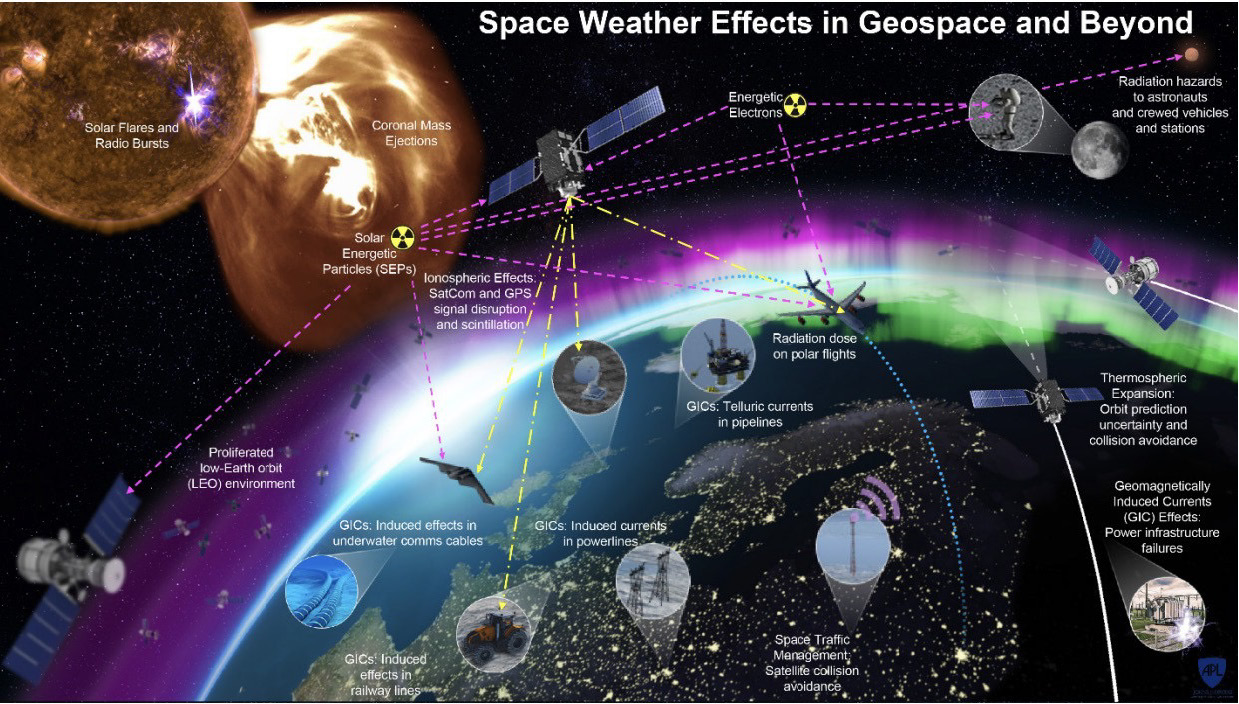
Space weather impacts are felt in space, in the atomosphere and on ground [Image credit: NASA/APL National Academies Space Physics Decadal 2024].
The Earth's magnetosphere, ionosphere, and atmosphere (MIA) work together as a dynamic space plasma system that shields our planet from the constant impact of the solar wind. Because of powerful solar driving, this MIA system coupling causes space weather— events that harm satellites and astronauts, disrupt GNSS-based navigation and communication, and damage power grids and pipelines on Earth. What makes space plasma physics especially exciting is that, unlike distant astrophysics systems that are out of reach, near-Earth space can be directly measured by spacecraft. Missions led by NASA, ESA, and CSA allow us to fly instruments through space plasmas and observe fundamental physical processes—such as particle acceleration, plasma waves, and turbulence—in real time. Advancing this research requires close collaborations across disciplines. Physicists work side by side with engineers, numerical modelers, and international mission teams to define science objectives, design instruments, plan and implement space missions, analyze data, and connect observations with theory and simulations. As satellites and CubeSats industry rapidly expands, studying space weather is not only a frontier of discovery but also a powerful training ground for careers in space research and the growing space industry.
Solar wind plasma and magnetic field interacting with Earth's magnetic field or the magnetosphere, a magnetic cavity region that protects us from the harsh interplanetary space environment. A process called magnetic reconnection drives plasma acceleration and energy transport, leading to auroral displays and space weather [video credit: NASA].
Space debris burned up over Puerto Rico on Feb. 7, 2022. It was likely from the SpaceX Starlink satellite batch that was doomed by a geomagnetic storm. The destruction of 40 Starlink satellites was attributed to unexpectedly increased atmospheric density and atmospheric drag [video credit: space.com].
Research
Wave Particle Interactions
Electron scattering by various types of plasma waves in the magnetosphere:
- Time domain structures (TDS) [Shen et al., 2020a; 2021b, 2024b, 2025]
- Whistler-mode waves [Shen et al., 2021a, 2022a, 2023b, 2024a, 2024b]
- Kinetic Alfvén waves [Liang, Shen et al., 2019; Shen et al., 2022b, 2022c, 2023b]
- Electron cyclotron harmonic (ECH) waves [Shen et al., 2025]
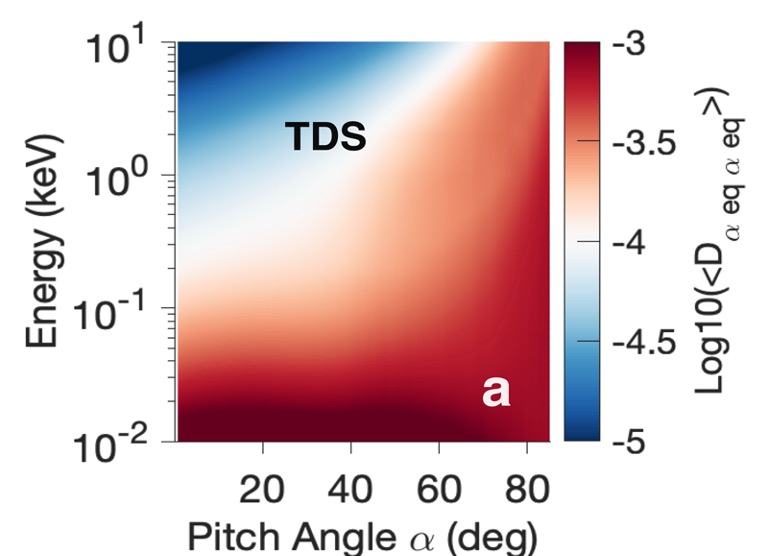
Electron pitch-angle (angle between velocity and background magnetic field) diffusion coefficients driven by time domain structures (TDS). The diffusion coefficients represent how fast electrons are scattered by the waves and dictate the evolution of electron distributions [Shen et al., 2024b].
Auroral Physics
Electron precipitation into different types of auroras:
- Diffuse auroras [Shen et al., 2020a, 2021b, 2024b, 2025]
- Alfvenic/discrete auroras [Liang, Shen et al., 2019; Shen et al., 2020c; Wu et al., 2021]
- Inverted-V/discrete auroras [Liu et al. 2024]
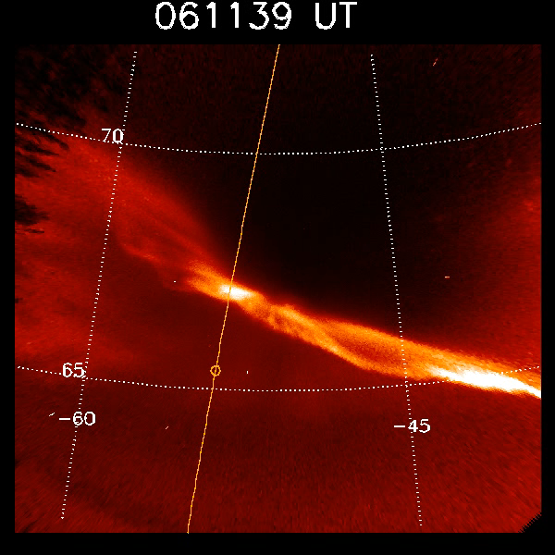
Alfvenic and inverted-V auroras observed by the red-line (630 nm emission) camera [Liang, Shen et al., 2019].
Auroral ionosphere disturbance
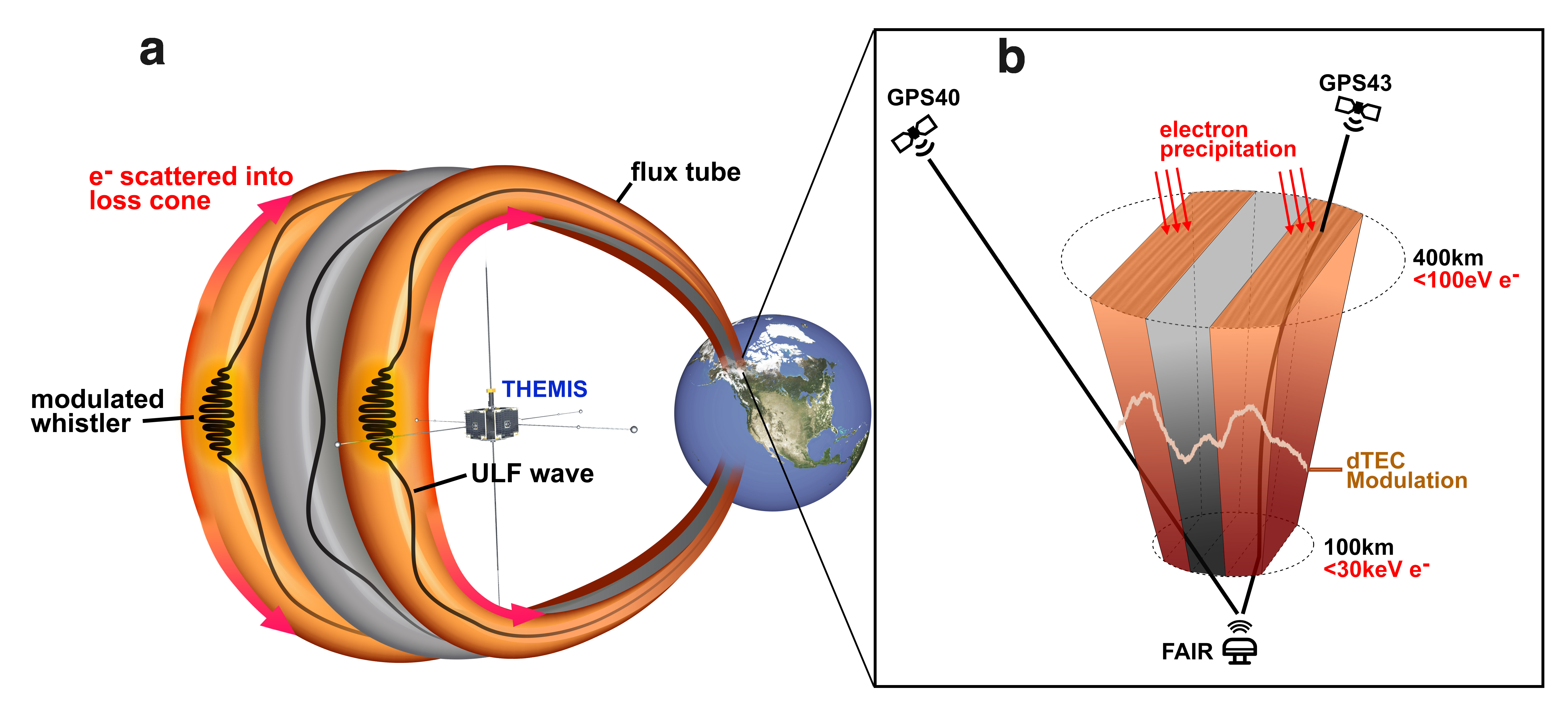
Spacecraft and ground-based observations of modulation of whistler-mode waves near the magnetic equator by ultra low frequency waves, electron scattering and precipitation into the ionosphere (red arrows) induced by whistler-mode waves, and precipitation-induced electron density and total electron content (TEC) perturbations that disrupt GPS communications [Shen et al., 2024a].
Publications
- Mourenas, D., Zhang, X., Kamaletdinov, S., Artemyev, A., Shen, Y., Ma, Q. (2025). Electron Nonlinear Interactions With Intense VLF Waves From Transmitters. J. Geophys. Res. Space Physics, e2025JA034757. https://doi.org/10.1029/2025JA034757
- Haas, B., Drozdov, A. Y., Goldstein, J., Ilie, R., Roy, A., Shen, Y., et al. (2025). Unraveling the mystery of Earth's space radiation environment loss processes: Meeting report. Earth and Space Science, 12, e2024EA004108. https://doi.org/10.1029/2024EA004108
- Shen, Y., Zhang, X., Liang, J., Artemyev, A., Angelopoulos, V., Spanswick, E., et al. (2025). Streamer-like red line diffuse auroras driven by time domain structures associated with electron injection and braking ion flows. Geophysical Research Letters, 52, e2025GL116516. https://doi.org/10.1029/2025GL116516
- Hartinger, M. D., Shi, X., Verkhoglyadova, O., Meng, X., Ozturk, D. S., Moore, A., Shen, Y., Artemyev, A., Gillies, D. M., Angelopoulos, V. (2025). Statistical analysis of ultra-low-frequency total electron content disturbances: Relationship to magnetospheric waves. J. Geophys. Res. Space Physics, 130, e2024JA033456. https://doi.org/10.1029/2024JA033456
- Tian, S., Yao, Z., Wygant, J., Lysak, R., Bortnik, J., Lyons, L., Liang, J., Shi, R., Ferradas, C., Shen, Y., Reeves, G. (2025). The energy source powering aurora through a static electric potential. Nature Communications.
- Shen, Y., Verkhoglyadova, O., Artemyev, A., Hartinger, M.D., Angelopoulos, V., Shi, X., Zou, Y. (2024a). Magnetospheric control of ionosphere TEC perturbations via whistler-mode and ULF waves. AGU Advances, 5, e2024AV001302. https://doi.org/10.1029/2024AV001302 (EOS AGU Advances Editor's Highlight, AGU Advances Cover Story)
- Shen, Y., Liang, J. Artemyev. A., Angelopoulos, V., Ma, Q., Lyons, L., et al. (2024b). Red line diffuse-like aurora driven by time domain structures associated with braking magnetotail flow bursts. Geophysical Research Letters, 51, e2024GL109000. https://doi.org/10.1029/2024GL109000
- Shen, Y., Artemyev, A. V., Angelopoulos, V., Liu, T., Vasko, I.. (2024c). Comparing plasma anisotropy associated with solar wind discontinuities and Alfvenic fluctuations. The Astrophysical Journal, 961, 41. https://doi.org/10.3847/1538-4357/ad110b
- Zou, Y., Zhang, X.-J., Artemyev, A.V., Shen, Y., Angelopoulos, V. (2024a). The key role of magnetic curvature scattering in energetic electron precipitation during substorms. Geophysical Research Letters, 51(14), e2024GL109227. https://doi.org/10.1029/2024GL109227
- Zou, Y., Gjerloev, J., Ohtani, S., Friel, M., Liang, J., Lyons, L.R., Shen, Y., Liu, J., et al. (2024b). An extreme auroral electrojet spike during 2023 April 24th storm. AGU Advances, 5(3), e2024AV001101. https://doi.org/10.1029/2024AV001101
- Liu, T.Z., Angelopoulos, V., Nishimura, Y., Shen, Y., Shi, X., Hartinger, M. (2024). Near-Earth reconnection powering recovery phase of geomagnetic storm. Geophys. Res. Lett., e2024GL112730. https://doi.org/10.1029/2024GL112730
- Shen, Y., Artemyev, A. V., Runov, A., Angelopoulos, V., Liu, J., Zhang, X.-J., et al. (2023a). Energetic electron flux dropouts measured by ELFIN in the ionospheric projection of the plasma sheet. J. Geophys. Res. Space Physics, 128, e2023JA031631. https://doi.org/10.1029/2023JA031631
- Shen, Y., Artemyev, A. V., Zhang, X.-J., Zou, Y., Angelopoulos, V., Vasko, I., et al. (2023b). Contribution of kinetic Alfvén waves to energetic electron precipitation from the plasma sheet during a substorm. J. Geophys. Res. Space Physics, 128, e2023JA031350. https://doi.org/10.1029/2023JA031350
- Angelopoulos, V., X.-J. Zhang, A. V. Artemyev, D. Mourenas, E. Tsai, C. Wilkins, A. Runov, J. Liu, D. L. Turner, W. Li, K. Khurana, R. E. Wirz, V. A. Sergeev, X. Meng, J. Wu, M. D. Hartinger, T. Raita, Y. Shen, X. An, et al. (2023). Energetic electron precipitation driven by electromagnetic ion cyclotron waves: First results from ELFIN. Space Science Reviews, 219, 37. https://doi.org/10.1007/s11214-023-00984-w
- Shen, Y., Artemyev, A. V., Ma, Q., Zhang, X.-J., Mourenas, D., Tsai, E., et al. (2022a). Inner belt wisp precipitation measured by ELFIN: Regimes of energetic electron scattering by VLF transmitter waves. J. Geophys. Res. Space Physics, 127, e2022JA030968. https://doi.org/10.1029/2022JA030968
- Shen, Y., Artemyev, A., Vasko, I., Zhang, X.-J., Angelopoulos, V., An, X., Runov, A. (2022b). Energetic electron scattering by kinetic Alfvén waves at strong magnetic field gradients of dipolarization front. Physics of Plasmas, 29, 082901. https://doi.org/10.1063/5.0096338
- Shen, Y., A. V. Artemyev, X.-J. Zhang, V. Angelopoulos, I. Y. Vasko, D. L. Turner, et al. (2022c), Tens to hundreds of keV electron precipitation driven by kinetic Alfvén waves during an electron injection, J. Geophys. Res. Space Physics, 127, e2022JA030360. https://doi.org/10.1029/2022JA030360
- Shen, Y., Chen, L., Zhang, X.-J., Artemyev, A., Angelopoulos, V., Cully, C. M, et al. (2021a). Conjugate observation of magnetospheric chorus propagating to the ionosphere by ducting. Geophysical Research Letters, 48, e2021GL095933. https://doi.org/10.1029/2021GL095933
- Shen, Y., Vasko, I.Y., Artemyev, A., Malaspina, D.M., Chu, X., Angelopoulos, V., & Zhang, X.J. (2021b). Realistic electron diffusion rates and lifetimes due to scattering by electron holes. J. Geophys. Res. Space Physics, 126, e2021JA029380. https://doi.org/10.1029/2021JA029380
- Khazanov, G.V., Shen, Y., Vasko, I.Y. Artemyev, A.V., & Chu, M. (2021). Magnetosphere-ionosphere coupling of precipitated electrons in diffuse aurora driven by time domain structures. Geophys. Res. Lett., 48, e2021GL092655. https://doi.org/10.1029/2021GL092655
- Wu, J., Knudsen, D.J., Shen, Y., & Gillies, D.M. (2021). E-POP observations of suprathermal electron bursts in the ionospheric Alfvén resonator. J. Geophys. Res., 126, e2020JA028005. https://doi.org/10.1029/2020JA028005
- Shen, Y., Artemyev, A., Zhang, X.-J., Vasko, I.Y., Runov, A., Angelopoulos, V., & Knudsen, D. (2020a). Potential evidence of low-energy electron scattering and ionospheric precipitation by time domain structures. Geophysical Research Letters, 47, e2020GL089138. https://doi.org/10.1029/2020GL089138
- Shen, Y. & Knudsen, D. J. (2020b). On O+ ion heating by BBELF waves at low altitude: Test particle simulations. J. Geophys. Res. Space Physics, 125. https://doi.org/10.1029/2019JA027291
- Shen, Y. & Knudsen, D. J. (2020c). Suprathermal electron acceleration perpendicular to the magnetic field in the topside ionosphere. J. Geophys. Res. Space Physics, 125, e2019JA027449. https://doi.org/10.1029/2019JA027449
- Liang, J., Shen, Y., Knudsen, D.J., Spanswick, E., Burchill, J., & Donovan, E. (2019). e-POP and red line optical observations of Alfvénic auroras. J. Geophys. Res. Space Physics, 124, 4672-4696. https://doi.org/10.1029/2019JA026679 (JGR Editor's Highlight)
- Shen, Y., D. J. Knudsen, J. K. Burchill, A. Howarth, A.Yau, D. M. Miles, H. G. James, G. W. Perry, L. Cogger (2018). Low-altitude ion heating, downflowing ions, and BBELF waves in the return current region. J. Geophys. Res. Space Physics, 123, 3087-3110. https://doi.org/10.1002/2017JA024955 (EOS Research Spotlight)
- Shen, Y., D. J. Knudsen, J.K. Burchill, et al. (2016). Strong ambipolar-driven ion upflow within the cleft ion fountain during low geomagnetic activity. J. Geophys. Res. Space Physics, 121(7), 6950-6969. https://doi.org/10.1002/2016JA022532
Contact
Please contact me regarding opportunities for:
- Undergraduate students
- Graduate students
- Postdoctoral scholars